FMCG

optimize inventory maximize sales

Our AI-powered BI helps answer three critical questions: what is happening, why it is happening, and what to do next, so decisions are made on time.

optimize inventory maximize sales
Microsoft Dynamics
Oracle E-Business Suite
Salesforce CRM
Sage ERP
Infor ERP
SAP ERP
Microsoft Dynamics
Oracle E-Business Suite
Salesforce CRM
Sage ERP
Infor ERP
SAP ERP
Microsoft Dynamics
Oracle E-Business Suite
Salesforce CRM
Sage ERP
Infor ERP
SAP ERP

FMCG Business Intelligence Services | Powered by AI

We deliver Business Intelligence services built specifically for FMCG businesses, enabling leaders to clearly see sales, inventory, distribution, and supply chain performance. Our AI-powered BI helps answer three critical questions: what is happening, why it is happening, and what to do next, so decisions are made on time.

FMCG teams often face delayed decisions because sales, inventory, and distribution data is spread across distributors, POS systems, ERP platforms, accounting tools, and spreadsheets. As a result, teams rely on manually compiled reports; numbers do not always match across departments, and insights arrive too late to act in fast-moving markets.
We address this by working closely with your teams to unify historical and live FMCG data into a single source of truth. Using proven FMCG KPIs and pre-built dashboards where applicable, we deliver custom BI solutions faster and at lower cost.
FMCG Business Intelligence Services | Powered by AI
FMCG BI Personas

FMCG CEO

Drive Overall Profitability and Brand Market Share
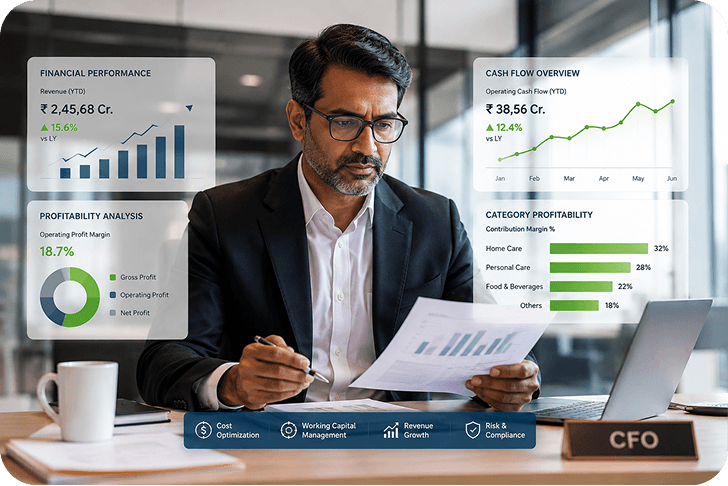
How can we increase our overall FMCG operating margins?
Which product categories are gaining market share and which are lagging?
How is our new product launch performing across different states?
Are we meeting our sustainability and governance targets?
Where should we allocate capital for maximum ROI next quarter?

AI in BI | From Data to Action

Our BI solution is powered by EVA, an AI-powered assistant embedded into our BI dashboards. It empowers users by allowing them to interact and communicate directly with their data. Users can ask questions in plain English and instantly receive clear, actionable insights. You can also attach external files such as PDFs and industry reports to provide additional context.
01

What Changed

AI instantly highlights unusual shifts in sales, inventory, or performance.
What Changed
02

Why It Changed

AI explains the key factors driving those changes, such as demand, pricing, or supply issues.
Why It Changed
03

What To Do Next

AI suggests actionable insights so leaders can respond quickly and confidently.
What To Do Next

FMCG BI That Delivers Measurable Financial Impact

Reduce stock-outs by 20–40%

Reduce stock-outs by 20–40%

Cut slow-moving inventory by 10–15%

Cut slow-moving inventory by 10–15%

Improve scheme and promotion ROI

Improve scheme and promotion ROI

Increase secondary sales across markets

Increase secondary sales across markets

Release working capital from excess inventory

Release working capital from excess inventory

Why Smart FMCG Leaders Still Make Slow Decisions

Store Sales Data Arrives Late

Store Sales Data Arrives Late

Daily store sales data is often available only after business hours or the next day. By the time leadership reviews performance, the opportunity to correct low sales or stock issues has already passed.

Sales And Inventory Data Don’t Match

Sales And Inventory Data Don’t Match

Sales data from POS systems, and inventory data from warehouses or stores frequently show different numbers. Teams spend time verifying data instead of acting on it, slowing down decision-making.

Limited SKU-Level Inventory Visibility

Limited SKU-Level Inventory Visibility

Retailers lack a clear view of inventory at the individual SKU and store level. This leads to fast-moving products going out of stock in some locations while excess inventory builds in others.

Forecasts Miss Real-Time Demand Changes

Forecasts Miss Real-Time Demand Changes

Demand forecasts rely heavily on historical data and do not adjust quickly to promotions, local events, or sudden changes in customer behavior. As a result, stock planning becomes inaccurate.

Manual Sales and Inventory Reporting

Manual Sales and Inventory Reporting

Sales and inventory reports are often created manually using spreadsheets. This process is time-consuming, error-prone, and delays access to critical performance insights.

Supply Issues Identified After Stockouts

Supply Issues Identified After Stockouts

Supply or distribution problems are usually discovered only after products are already unavailable on shelves. This results in lost sales and poor customer experience.

How Business Intelligence Empowers Leaders?

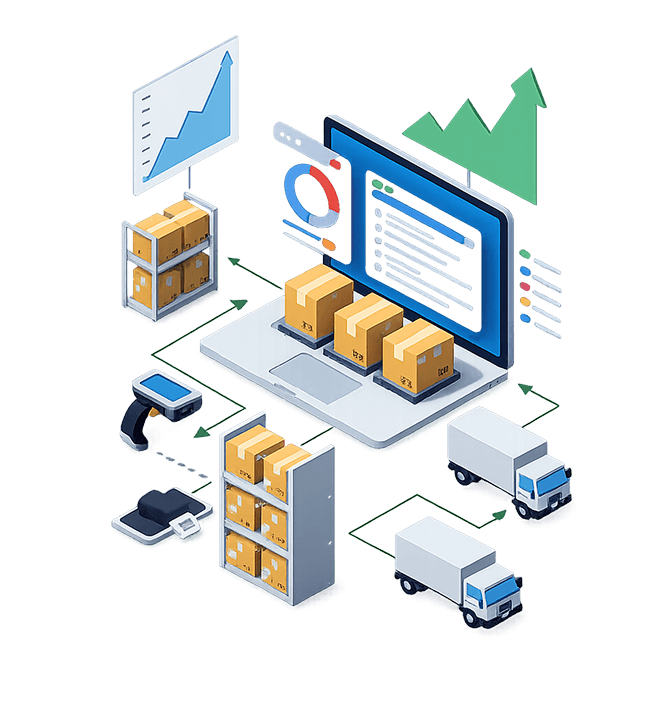
Data from different sources is brought together into a central Data Warehouse, where it is organized and aligned to create reliable KPIs. This trusted data powers dashboards and insights and also enables AI-driven capabilities.

Real-Time Store Sales Visibility

Real-Time Store Sales Visibility

Business Intelligence brings store sales data from POS systems into live dashboards. FMCG leaders can monitor performance during the day and take action before sales opportunities are lost.

Single Source of Sales and Inventory Data

Single Source of Sales and Inventory Data

Business Intelligence unifies sales and inventory data into one consistent view. This removes confusion between teams and enables faster, more confident decisions.

SKU-Level Inventory Visibility Across Markets

SKU-Level Inventory Visibility Across Markets

Business Intelligence provides clear visibility into inventory at SKU and market levels. Leaders can quickly identify slow-moving products, stock gaps, and excess inventory.

Real-Time Demand Forecasting

Real-Time Demand Forecasting

Business Intelligence continuously updates forecasts using current sales trends and demand signals. This helps FMCG teams respond quickly to market changes instead of relying only on past data.

Automated Sales and Inventory Reporting

Automated Sales and Inventory Reporting

Business Intelligence automates reporting across systems and eliminates manual spreadsheets. Teams get timely, accurate insights without delays or errors.

Early Detection of Supply Issues

Early Detection of Supply Issues

Business Intelligence monitors supply and distribution data continuously. Potential disruptions and stock risks become visible before stockouts occur.

Business Intelligence Use Cases Across FMCG Operations

BI services deliver value across industries, but its real impact comes from how well insights are aligned with industry-specific challenges, metrics, and decision cycles. Our BI solutions built on Power BI are designed to reflect how each industry actually operates.

Are You Losing Sales Due to Stock-Outs?
Stock-Out & Availability

Are You Losing Sales Due to Stock-Outs?

  • Prevent stock-outs at high-demand outlets
  • Identify gaps in distributor and outlet coverage
  • Ensure availability of fast-moving SKUs
  • Reduce lost sales due to poor replenishment
  • Maintain consistent on-shelf availability

Data Sources We Integrate

Each industry card now states the operational value clearly instead of burying it in broad text.

Google Products

Google Products

Pricing Software

Pricing Software

Accounting Software

Accounting Software

CRM

CRM

MIS Reports

MIS Reports

SCM Software

SCM Software

POS

POS

External Data

External Data

Frequently Asked Questions

Get the information you need with our frequently asked questions.
Business Intelligence is how leaders turn raw data into clear, decision-ready insights. It connects data from across the business, explains what is happening and why, and highlights where attention is needed, so decisions are based on facts, not assumptions.
Our BI solution caters extensively to FMCG, Retail, Manufacturing, Logistics, Healthcare, and Corporate Management, helping optimize routes, reduce stock-outs, and analyze sales performance.
Yes! Our BI dashboards are completely responsive and accessible across all devices, including laptops, tablets, and smartphones, so you can track operations on the go.
Absolutely. We design and tailor custom dashboards, metric calculations, and automated reports to fit the unique operational goals and data infrastructure of your business.
We integrate with a wide variety of data sources, including ERP systems (SAP, Oracle, Sage), POS terminals, CRM software, pricing engines, warehouse databases, and external flat files (CSV, Excel).
Yes, powered by EVA, our AI-powered assistant, the BI platform analyzes historical data to detect anomalies, explains key contributors, and automatically recommends action steps.
Most organizations witness direct financial returns, such as reduced inventory holding costs and improved promotion ROI, within the first 4 to 8 weeks of full integration.

Enable Digital Transformation of Your Business with Our Wide Range of IT Services